ENSO Pregnancy Report Came Out Negative For October – Reconceived La Niña In November : But a Full-Fledged La Niña Is Theoretically Unlikely During Indian Winter 2025-26
Click here for Gujarati version – ગુજરાતી માં વાંચવા માટે ક્લિક કરો
Enso Status on 5th December 2025
Analysis & Commentary by Ashok Patel
Several international meteorological agencies, including the Indian Meteorological Department and various private meteorological organizations in India, had anticipated the development of a La Niña event during the Indian Winter Season of 2025/26. Here is my take !
ENSO Thought To Have Conceived La Niña In October – Report Came Negative!
The ASO ( August–September–October ) ONI value has touched –0.5°C, meaning the first La Niña threshold had been barely achieved by rounding of ONI value of –0.4533°C to –0.5°C. However, the Nino3.4 SST for October has been revised down from 0.53°C to 0.50°C, thereby ONI value came down to –0.4°C and nullified the First La Nina thresh hold for ASO 2025. That’s like saying October ENSO pregnancy report came negative.
The latest ONI for SON 2025 has the ONI at 0.6°C and so the La Niña pregnancy is one month old as of end-November 2025. ENSO requires full five months of pregnancy to give birth to a little child – La Niña.
For a full-fledged La Niña, NOAA requires five consecutive overlapping 3-month periods (ONI) at or below –0.5°C.
Since SON 2025 marks the start, the subsequent four periods — OND, NDJ, DJF and JFM 2025-26 — would complete the five-month cycle.
- ONI Data has been obtained from CPC – NWS – NOAA available here
Nuances & Rounding Issues in La Niña Thresholds:
The October case demonstrates how small SST adjustments or rounding (–0.4533°C → –0.5°C) can momentarily push an index across the threshold.
Also important:
-
CPC currently uses the 1991–2020 base period
-
Every five years the base period is updated
-
In January 2026, the new 1996–2025 climatology will take effect
-
This may cause small revisions in recent ONI values and could slightly shift thresholds again
Hence, the current La Nina thresh hold will be revisited in January 2026 when the new climatological base period 1996-2025 will be adopted. See details
Final take: Based on this analysis and NOAA criteria, it is expected that the Indian Winter of 2025-26 (December 2025- February 2026) will have concluded by the time a fully developed La Niña is recorded by NOAA if at all it materializes. There could even be a possibility that although the first La Nina thresh is attained and these thresh holds exceed only for a total period of 4 or less consecutive overlapping 3-month seasons, then historically this period will be considered as Enso Neutral.
How ONI is Determined
ONI is based on:
-
Three-month running mean of SST anomalies in the Niño 3.4 region (5°N–5°S, 170°W–120°W)
-
Using the ERSST.v5 dataset
-
Compared against the 30-year climatological baseline
-
Used as the principal ENSO monitoring index
CPC considers ENSO conditions present when:
-
Niño3.4 SST anomalies meet or exceed ±0.5°C
-
Consistent atmospheric indicators accompany the SST signal
-
Persistence is expected for the next 3 months
The Climate Prediction Center (CPC) is a division of NOAA’s National Centers for Environmental Prediction (NCEP).
Latest Oceanic Nino Index Graph Shows First La Nina
Thresh Hold Achieved At The End Of November 2025
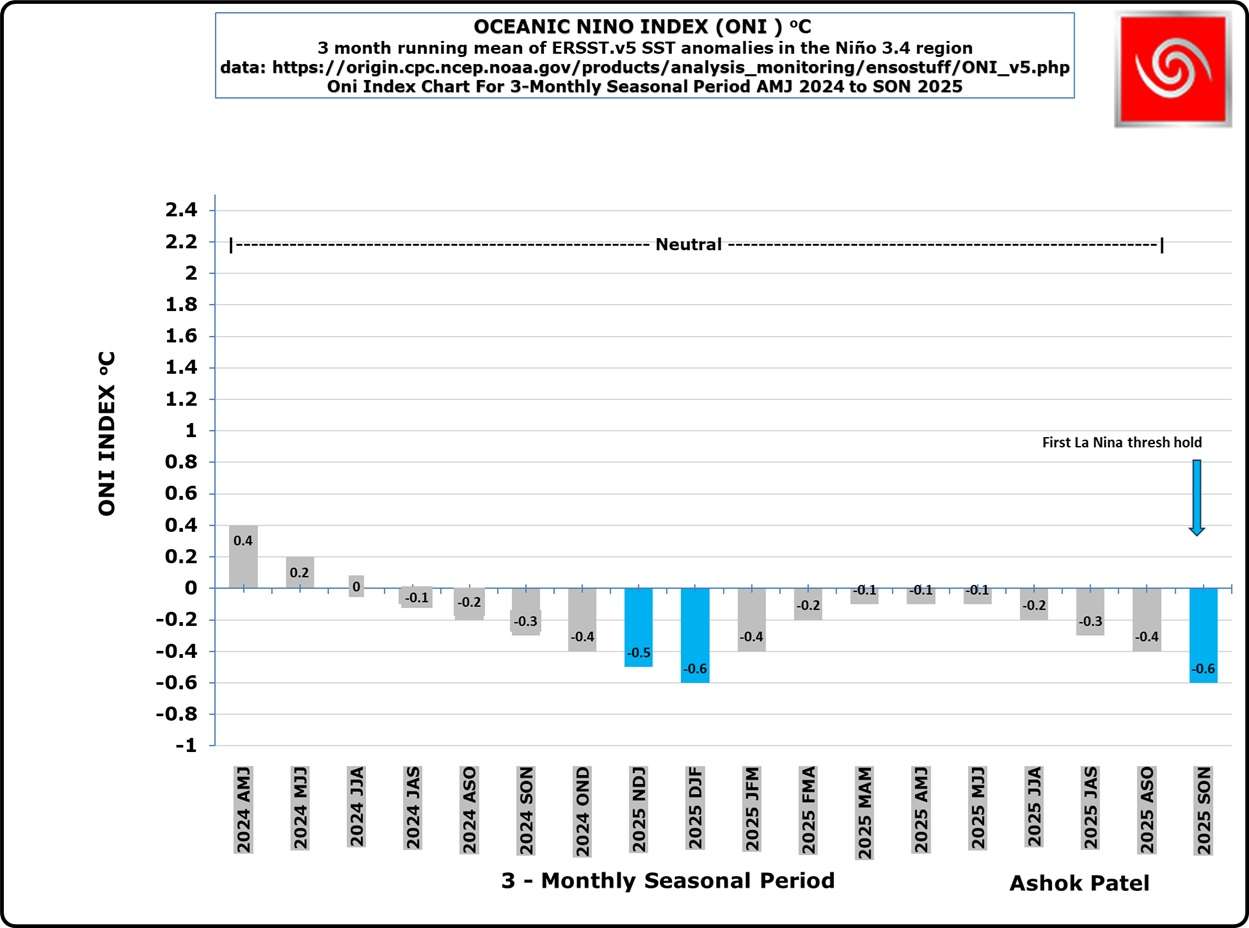
The Table below shows the monthly SST of Nino3.4 Region and the Climate adjusted normal SST and SST anomaly from April 2024. Climate Base 1991-2020. ERSST.v5
Period    Nino3.4 ClimAdjust
YR   MON  Temp.ºC Temp.ºC ANOM ºC


2024   4   28.60   27.83    0.77
2024   5   28.17   27.94    0.23
2024   6   27.90   27.73    0.18
2024   7   27.34   27.29    0.05
2024   8   26.74   26.86   -0.12
2024   9   26.46   26.72   -0.26
2024  10   26.45   26.72   -0.27
2024  11   26.46   26.70   -0.25
2024  12   26.00   26.60   -0.60
2025   1   25.82   26.55   -0.73
2025   2   26.34   26.76   -0.43
2025   3   27.31   27.29    0.01
2025   4   27.69   27.83   -0.14
2025   5   27.81   27.94   -0.13
2025   6   27.66   27.73   -0.06
2025   7   27.15   27.29   -0.14
2025   8   26.50   26.86   -0.36
2025   9   26.25   26.72   -0.47
2025  10   26.22   26.72   -0.50
2025  11   26.02   26.70   -0.69
Indications and analysis of various International Weather/Climate agencies monitoring Enso conditions is depicted hereunder:
Summary by: Climate Prediction Center / NCEP Dated 1st December 2025
ENSO Alert System Status: La Niña Advisory
La Niña is present.*
Equatorial sea surface temperatures (SSTs) are below average across the central and east-central Pacific Ocean.
Atmospheric anomalies over the tropical Pacific Ocean are consistent with La Niña.
La Niña is favored to continue into the Northern Hemisphere winter, with a transition to ENSO-neutral most likely in January-March 2026 (61% chance).*
Note: Statements are updated once a month (2nd Thursday of each month) in association with the ENSO Diagnostics Discussion, which can be found by clicking here.
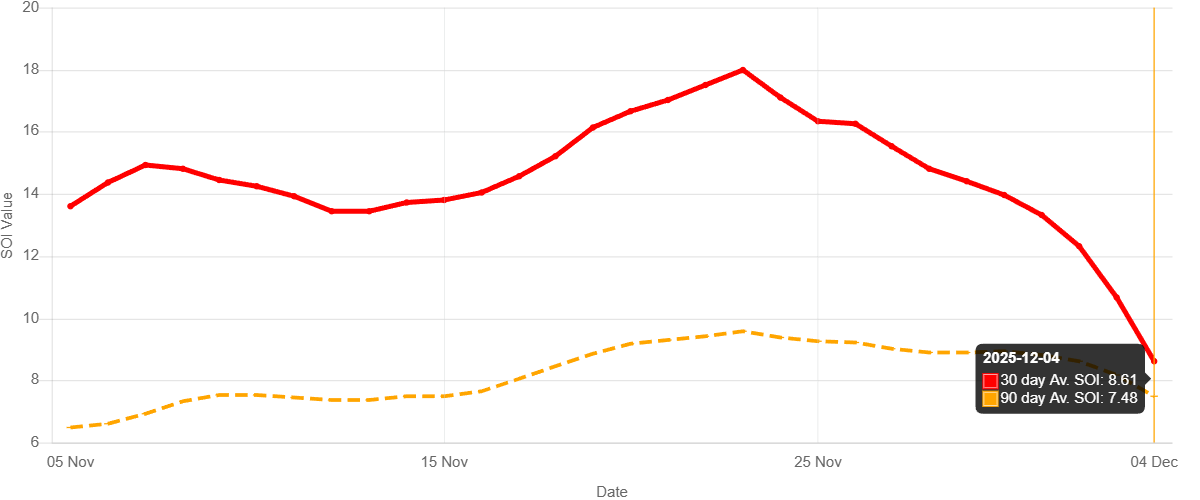
Recent (preliminary) Southern Oscillation Index values as per The Long Paddock – Queensland Government.
30 Days average SOI was +13.95 at the end of November 2025 and was +8.61 on 4th December 2025 as per The Long Paddock – Queensland Government and 90 Days average SOI was +7.48 on 4th December 2025. The monthly values are in positive zone.
As per BOM – Australia 27th November 2025
La Niña in the tropical Pacific
-
La Niña is underway in the tropical Pacific, with strong ocean–atmosphere coupling now evident.
-
Niño3.4 index for week ending 23 Nov: –0.93°C (La Niña threshold < –0.8°C).
-
Trade winds, cloud patterns and pressure fields consistently support La Niña since September.
-
SOI: 30-day +16.1 (boosted by Cyclone Fina); 90-day +8.5 (firm La Niña signal).
-
Outlook: BOM models expect La Niña conditions to persist into early 2026, then return to neutral — aligned with most global models.
-
- BOM has introduced Relative Niño indices
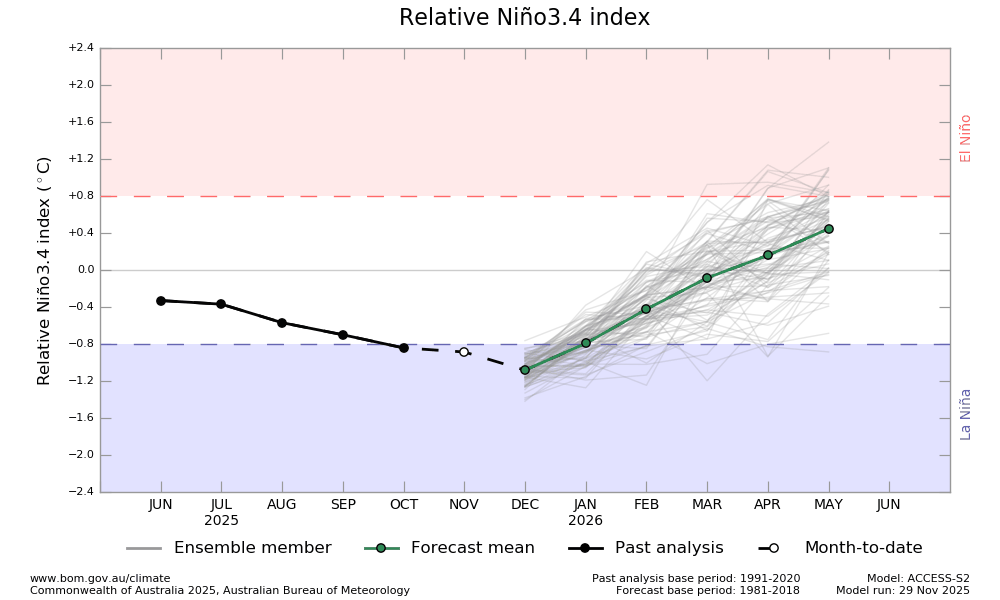
The details about Relative Index is here