Enso Status on 6th November 2025
Analysis & Commentary by Ashok Patel
Several international meteorological agencies, including the Indian Meteorological Department and various private meteorological organizations in India, have anticipated the development of a La Niña event during the Indian Winter Season of 2025/26. Here is my take !
ENSO Has Conceived – It’s a La Niña!
But a Full-Fledged La Niña Is Theoretically Unlikely During Indian Winter 2025-26
(Relying on NOAA criteria)
The ASO ( August–September–October ) ONI value has touched –0.5 °C, meaning the first La Niña threshold has been achieved. ( This thresh hold was barely achieved by rounding of ONI value of –0.4533 °C )
That’s like saying ENSO has conceived a baby girl, and the La Niña pregnancy is one month old as of end-October 2025. ENSO requires full five months of pregnancy to give birth to a little child – La Niña.
For a full-fledged La Niña, NOAA requires five consecutive overlapping 3-month periods at or below –0.5 °C.
Since ASO 2025 marks the start, the subsequent four periods — SON, OND, NDJ, and DJF 2025-26 — would complete the five-month cycle.
If the cooling continues steadily, La Niña can be formally recognized by the end of February 2026.
However, at that time the Indian winter (December 2025 – February 2026) will have concluded, at the birth of a fully developed La Niña if at all it materializes.
What is a Fully Developed La Niña?
To understand anticipated La Niña, it’s important to define what constitutes a “fully developed La Niña,” or a “full-fledged La Niña,” based on NOAA’s operational definitions for ENSO (El Niño-Southern Oscillation):
- El Niño is characterized by a positive Oceanic Niño Index (ONI) greater than or equal to +0.5ºC.
- La Niña is defined by a negative ONI less than or equal to -0.5ºC.
For an event to be classified as a full-fledged El Niño or La Niña, the respective ONI threshold must be exceeded for at least five consecutive overlapping 3-month periods (or seasons).
ONI Data has been obtained from CPC – NWS – NOAA available here
First La Niña Threshold Achieved — Just Barely
The Oceanic Niño Index (ONI) has further decreased, barely reaching –0.5 °C for the ASO (August–September–October) 2025 season, thus achieving the first La Niña threshold by the end of October 2025.
This marks the transition into a La Niña state from the ASO (August September–October) 2025 season.
A nuance worth noting is that the Niño 3.4 sea surface temperature (SST) for August at –0.36 °C, September at –0.47 °C, and October at –0.53 °C of 2025 combined total is –1.36 °C, which corresponds to an ONI value of –0.453 °C.
Hence, the La Niña threshold of –0.5 °C has been barely met — thanks to ONI’s rounding convention (values of –0.45 °C or lower are rounded to –0.5 °C).
This subtle rounding makes the difference between a “near-miss” and an “official threshold achieved”, highlighting how marginal this initial La Niña signal really is.
Currently the past 30-year base period 1991–2020 is used to compute monthly average SST for Nino 3.4 Region, and it will continue to be used to compute the departure from average. However, CPC creates an additional 30-year base period every 5 years (the next update will be at the beginning of 2026). When these 5 year updates occur, the ONI values over the most recent decade will change slightly because of the inclusion of more recent data. Hence, the current La Nina thresh hold will be revisited in January 2026 when the new climatological base period 1996-2025 will be adopted. See details
Final take: Based on this analysis and NOAA criteria, it is expected that the Indian Winter of 2025-26 (December 2025- February 2026) will have concluded by the time a fully developed La Niña is recorded by NOAA. There could even be a possibility that although the first La Nina thresh is attained and these thresh holds exceed only for a total period of 4 or less consecutive overlapping 3-month seasons, then historically this period will be considered as Enso Neutral.
How ONI is determined:
The ONI is based on SST departures from average in the Niño 3.4 region, and is a principal measure for monitoring, assessing, and predicting ENSO. Defined as the three-month running-mean SST departures in the Niño 3.4 region. Departures are based on a set of improved homogeneous historical SST analyses (Extended Reconstructed SST – ERSST.v5).
NOAA Operational Definitions for El Niño and La Niña, El Niño: characterized by a positive ONI greater than or equal to +0.5ºC. La Niña: characterized by a negative ONI less than or equal to -0.5ºC. By historical standards, to be classified as a full-fledged El Niño or La Niña episode, these thresholds must be exceeded for a period of at least 5 consecutive overlapping 3-month seasons.
CPC considers El Niño or La Niña conditions to occur when the monthly Niño3.4 OISST departures meet or exceed +/- 0.5ºC along with consistent atmospheric features. These anomalies must also be forecast to persist for 3 consecutive months.
The Climate Prediction Center (CPC) is a United States Federal Agency that is one of the NECP, which are a part of the NOAA
Latest Oceanic Nino Index Graph Shows First La Nina
Thresh Hold Achieved At The End Of October 2025
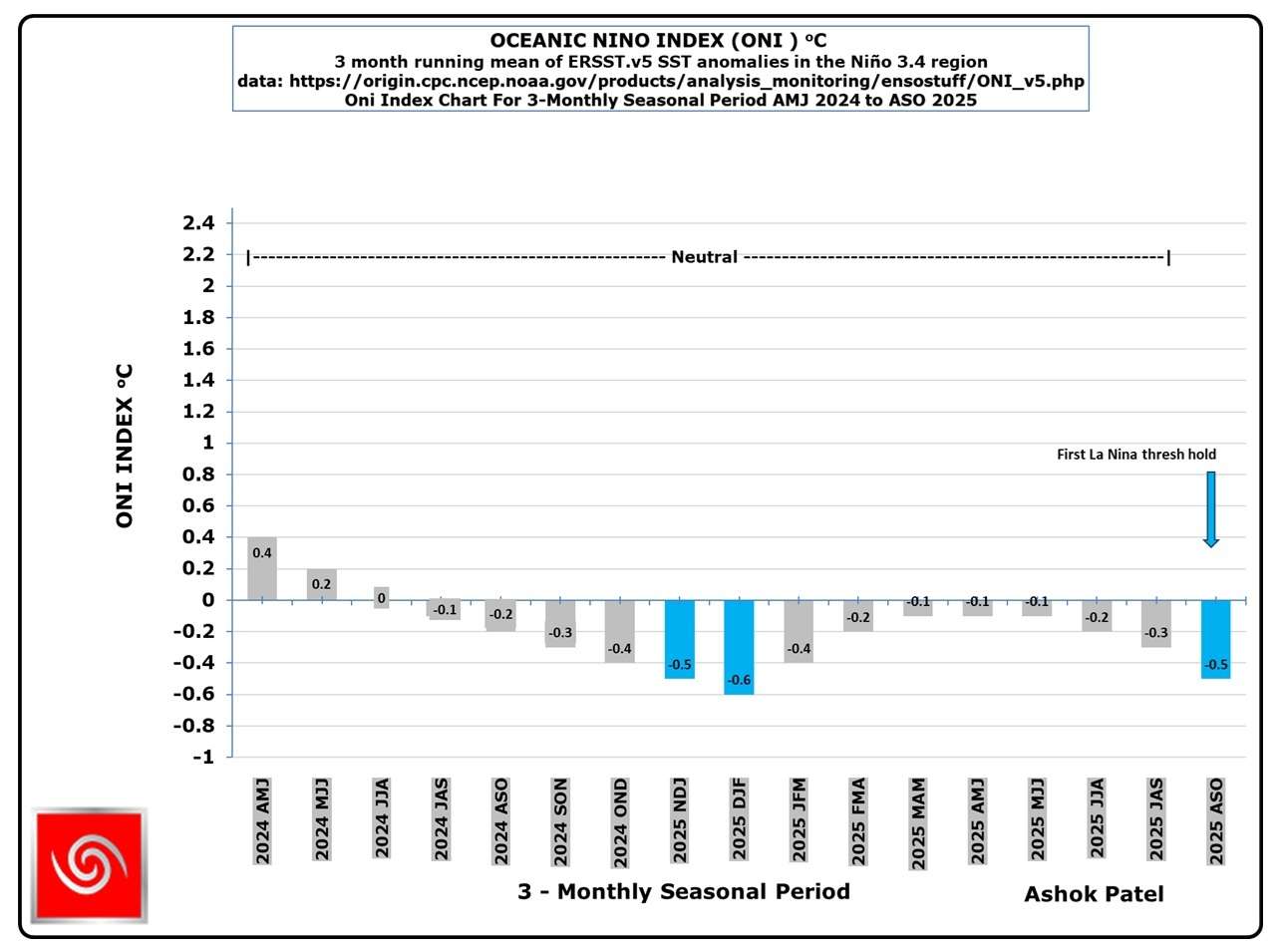
The Table below shows the monthly SST of Nino3.4 Region and the Climate adjusted normal SST and SST anomaly from April 2024. Climate Base 1991-2020. ERSST.v5
Period    Nino3.4 ClimAdjust
YR   MON  Temp.ºC Temp.ºC ANOM ºC


2024   4   28.60   27.83    0.77
2024   5   28.17   27.94    0.23
2024   6   27.90   27.73    0.18
2024   7   27.34   27.29    0.05
2024   8   26.74   26.86   -0.12
2024   9   26.46   26.72   -0.26
2024  10   26.45   26.72   -0.27
2024  11   26.46   26.70   -0.25
2024  12   26.00   26.60   -0.60
2025   1   25.82   26.55   -0.73
2025   2   26.34   26.76   -0.43
2025   3   27.31   27.29    0.01
2025   4   27.69   27.83   -0.14
2025   5   27.81   27.94   -0.13
2025   6   27.66   27.73   -0.06
2025   7   27.15   27.29   -0.14
2025   8   26.50   26.86   -0.36
2025   9   26.25   26.72   -0.47
2025  10   26.19   26.72   -0.53
Indications and analysis of various International Weather/Climate agencies monitoring Enso conditions is depicted hereunder:
Summary by: Climate Prediction Center / NCEP Dated 3rd November 2025
ENSO Alert System Status: La Niña Advisory
La Niña conditions are present.*
Equatorial sea surface temperatures (SSTs) are mostly below average across most of the Pacific Ocean.
Atmospheric anomalies over the tropical Pacific Ocean are consistent with La Niña.
La Niña conditions are present and favored to persist through December 2025 – February 2026, with a transition to ENSO-neutral likely in January-March 2026 (55% chance).*
Note: Statements are updated once a month (2nd Thursday of each month) in association with the ENSO Diagnostics Discussion, which can be found by clicking here.
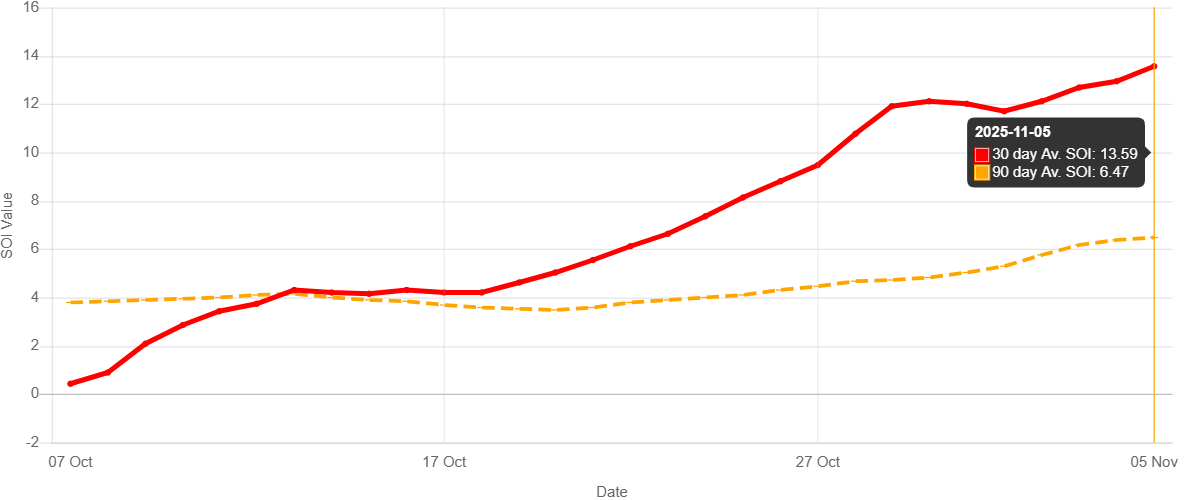
Recent (preliminary) Southern Oscillation Index values as per The Long Paddock – Queensland Government.
30 Days average SOI was +12.07 at the end of October 2025 and was +13.59 on 5th November 2025 as per The Long Paddock – Queensland Government and 90 Days average SOI was +6.47 on 5th November 2025. The monthly values are in positive zone.
As per BOM – Australia 1st November 2025
- The El Niño–Southern Oscillation (ENSO) remains neutral. While there are signs of possible La Niña development in the tropical Pacific Ocean and atmosphere, these signals have not yet been sustained at a sufficient strength or duration to meet Bureau criteria for an active event.
- The latest relative Niño3.4 SST index value for the week ending 26 October 2025 is −0.86 °C. The weekly values of the relative Niño3.4 index have been fluctuating around the La Niña threshold since mid-to-late September. Index values between –0.8 °C and +0.8 °C are considered ENSO-neutral while sustained values below –0.8 °C (for at least 3 months) are considered indicative of La Niña.
- Some atmospheric indicators, such as trade winds, pressure and cloud patterns over the equatorial central Pacific, show some signs of La Niña development. The 30-day Southern Oscillation Index (SOI) has just recently exceeded +7, although the 90-day SOI remains neutral. The Madden–Julian Oscillation is currently, as at 26 October 2025, enhancing trade winds over the western Pacific, which may provide a short-term boost towards La Niña conditions.
- Under Bureau criteria, La Niña is considered established when sustained cool waters in the central tropical Pacific (relative Niño3.4 index values below –0.8 °C for at least 3 months) are accompanied by a consistent atmospheric response.
- The Bureau’s model currently predicts that tropical Pacific Ocean temperatures are likely to just meet La Niña levels during November and December, before returning to neutral. This timing aligns with most international models assessed, although they generally show slightly more cooling, compared to the Bureau’s model.
- The Southern Annular Mode (SAM) index is negative as at 25 October. It is forecast to increase in the coming days to neutral SAM levels and remain so for the at least the next fortnight.
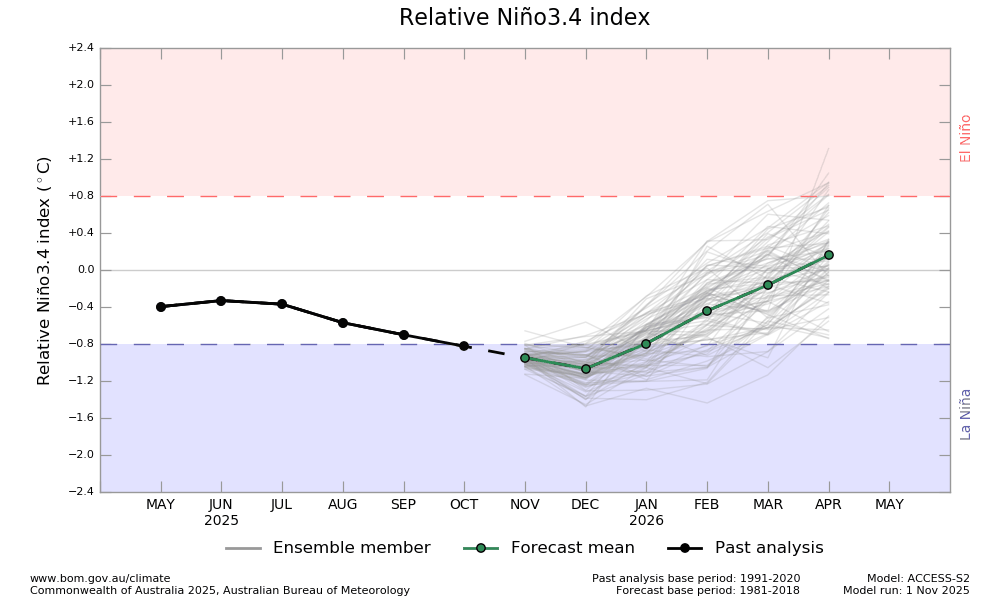
BOM has introduced Relative Niño indices
The details about Relative Index is here