A Historical El Niño (2019-2020) Created by a Climatology Update
9 January 2026
Important Note on ONI Revisions
The CPC has implemented its latest climatological base-period update, shifting the reference climatology to 1996–2025 as part of its routine five-year revision cycle. Adopted in January 2026, this change has materially altered the historical ENSO record—not by changing the ocean, but by changing how anomalies are defined.
The Oceanic Niño Index (ONI) is calculated as sea-surface temperature anomalies in the Niño-3.4 region relative to a rolling 30-year “normal.” Each forward shift of this baseline redefines what constitutes normal conditions. While such updates often result in a warmer baseline, the latest revision has cooled the Niño-3.4 climatological mean, as clearly reflected in the historical SST climatology.
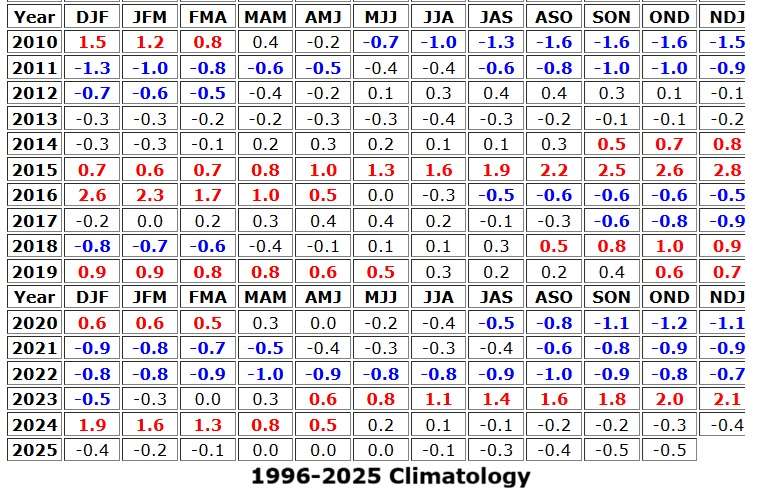
As a direct consequence, the period October–December 2019 through February–April 2020, previously classified as ENSO-neutral under the 1991–2020 baseline, now satisfies the formal threshold for a weak El Niño. This reclassification effectively creates a historical El Niño (2019-2020) event that was never identified in real time.
Crucially, the underlying oceanic conditions have not changed. What has changed is the statistical reference against which those conditions are measured. This episode demonstrates that ENSO classifications are not absolute physical truths; they are diagnostic constructs that depend explicitly on the chosen climatological baseline.
For researchers, forecasters, and communicators, this serves as a clear caution: ENSO “history” is not immutable. When the yardstick is recalibrated, past classifications can—and do—change. 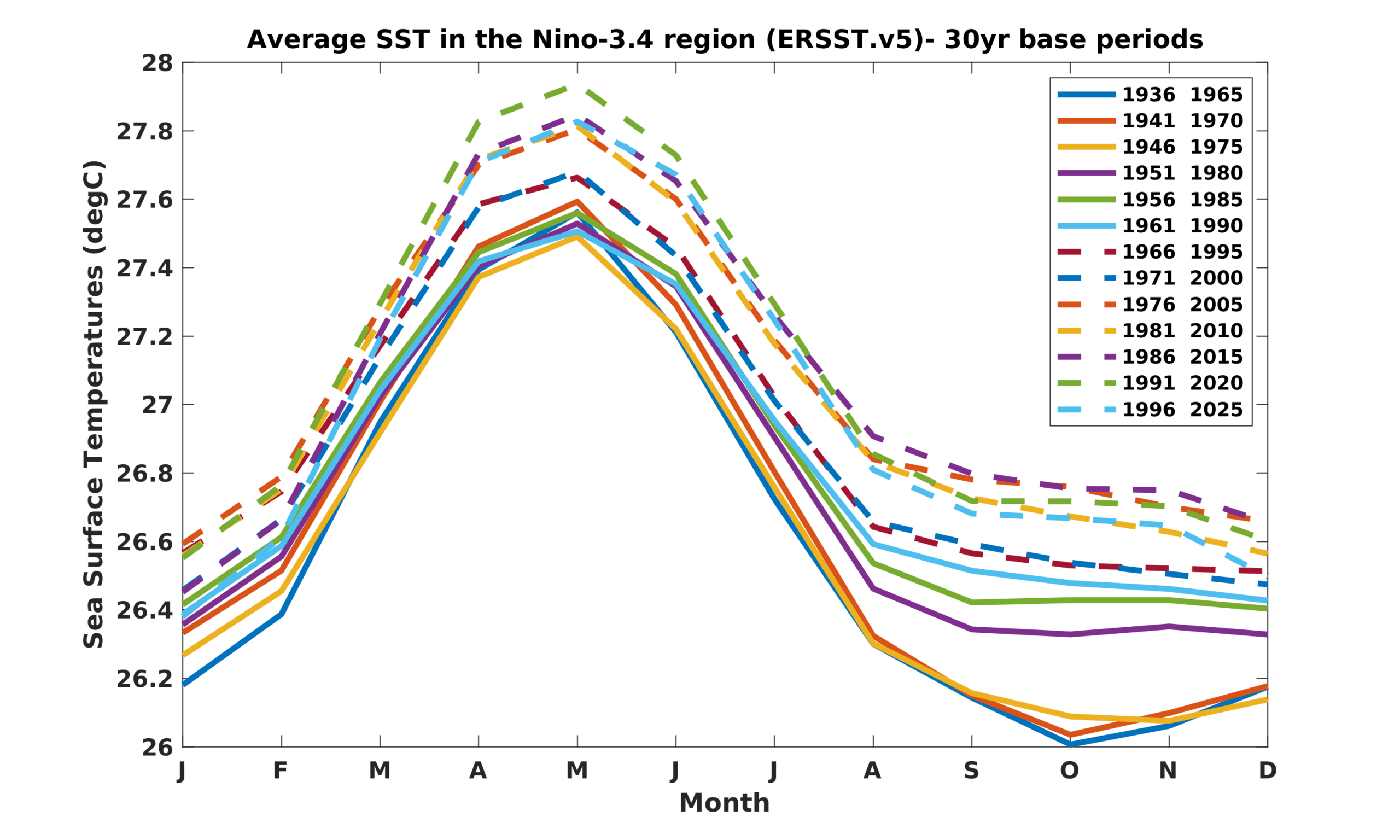
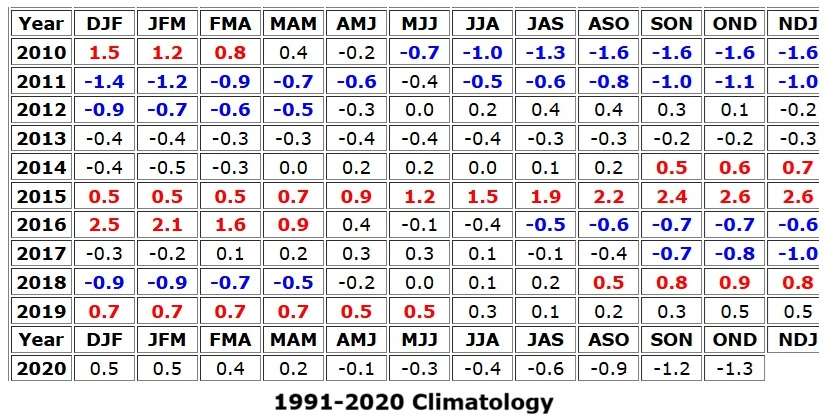
The above CPC ONI Table shows the ENSO Neutral conditions for OND 2019 to FMA 2020